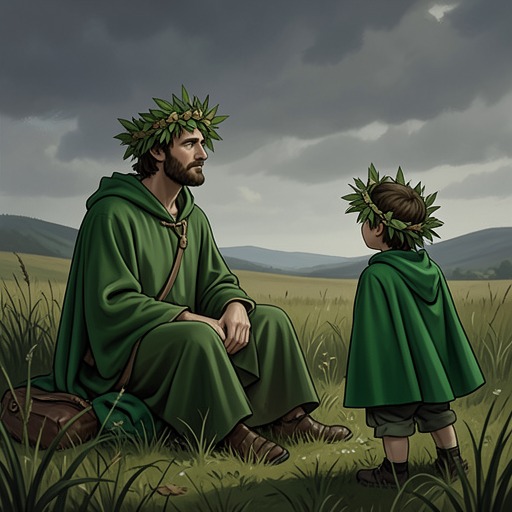
Greensight
A Clash of KingsGreensight is an ancient form of prophetic or transpersonal knowledge associated with the Children of the Forest and their wise men, the greenseers. In the account given at Winterfell, it is described not simply as spellcasting but as a different kind of perception: the greenseers were believed to see through the eyes of the weirwoods and to exercise power over animals, birds, and even fish. Its possible survival in Jojen Reed’s dreams creates a direct conflict between inherited lore, personal experience, and the authority of learned skepticism.
Definition and Ancient Origins
Maester Luwin explains that the Children of the Forest were said to possess greensight, and that their wise men were called greenseers. He refuses to give the ability a simple supernatural definition, telling Bran Stark that it may be called magic only because ordinary language lacks a better term; at its heart, he presents it as a different sort of knowledge. This formulation leaves greensight suspended between magic and an unknown natural faculty rather than confirming either explanation.
The tradition is connected to the faces carved in the weirwood trees. The First Men believed that greenseers could see through the eyes of those trees, which made the weirwoods more than religious monuments or living witnesses: they were imagined as a network of perception. That belief also explains a historical pattern of violence. The First Men supposedly cut down weirwoods when they fought the Children of the Forest because destroying the trees was thought to deny the greenseers their sight.
Greensight was not limited, in the old accounts, to visions of the future. Luwin says that greenseers supposedly held power over the beasts of the wood, the birds in the trees, and even fish. The tradition therefore combines prophecy with a form of communion or command over the nonhuman world, linking human knowledge to trees, animals, and the wider living environment.
Jojen Reed and the Green Dreams
The question of whether greensight still exists is raised through Jojen Reed. Meera Reed tells Bran that her brother has greensight because he dreams things that have not happened and sometimes sees those dreams fulfilled. She distinguishes his ordinary dreams from the green dreams, insisting that the latter are different and carry a truth that ordinary sleep does not.
Jojen’s manner reinforces the ambiguity of his claim. His eyes are described as moss-colored, and at times his gaze seems directed toward something beyond the person before him. He reports a green dream in which a winged wolf is bound to the earth by grey stone chains. A crow tries to peck through the chains, but the stone is too hard and the crow can only chip at it. Jojen knows the dream is true because it was a green dream, not because he can offer an ordinary chain of evidence.
The image becomes more specific when Bran asks whether the crow had three eyes. Jojen nods. The answer connects the dream to the three-eyed crow and turns the vision into a compact structure of captivity, attempted release, and obstructed knowledge. Yet the scene does not explain the image conclusively. Its meaning remains something Bran must confront rather than something the characters can scientifically verify.
Skepticism and the Authority of Knowledge
Maester Luwin challenges the claim that Jojen possesses greensight. He acknowledges that Jojen may have had dreams he believes came true, but concludes that Jojen does not have the power because no living man has it. Luwin supports this judgment by appealing to the disappearance of the Children of the Forest and the loss of their wisdom: if the beings who possessed the tradition are gone, the ability is presumed to have vanished with them.
Luwin’s skepticism is not simple mockery. He warns that people who call themselves mages and warlocks may merely perform tricks, recalling a Citadel acquaintance who could pull a rose from someone’s ear without being any more magical than Luwin himself. He also admits that human beings understand very little of the world when measured against the vastness of time. Mountains, rivers, stars, cities, and even gods appear permanent only because an individual life is too short to witness their transformation.
That broad historical perspective leads Luwin to argue that magic may once have been a mighty force but has faded into the remnant of a burnt fire. He names Valyria as the last ember and associates its disappearance with the extinction or forgetting of dragons, giants, and the Children of the Forest. His conclusion is categorical, but the scale of his own argument quietly weakens certainty: the world is full of changes that human observers cannot live long enough to see.
Belief, Denial, and Narrative Significance
Greensight matters because it establishes a struggle over who is entitled to define reality. Meera trusts Jojen’s green dreams as a form of truth, while Luwin interprets them through probability and the ordinary unreliability of dreams. He reminds Bran that Bran once dreamed of his father in the crypts before the death was known, but uses that apparent fulfillment to argue that everyone’s dreams can occasionally coincide with reality. The same kind of experience therefore becomes evidence for prophecy to one character and evidence against prophecy to another.
Bran is caught between these interpretations. After Summer tried to hurt Jojen, Bran apologizes for the wolves’ behavior but also rejects the claims made about his dreams, calling the crow’s promise that he could fly a lie and accusing Jojen of lying as well. His response is a refusal to accept a frightening interpretation of his own experience before he understands it. Meera answers only that Luwin may be wrong, preserving the uncertainty rather than resolving it.
The passage consequently presents greensight as a state of contested knowledge rather than a settled system of magic. Its ancient description gives the concept a coherent history; Jojen’s dream supplies a vivid possible instance; Luwin’s account explains why the power should have disappeared; and Meera’s defiance keeps the supernatural possibility alive. Greensight becomes significant precisely because the narrative allows prophecy, coincidence, lost knowledge, and denial to occupy the same space without immediately choosing among them.